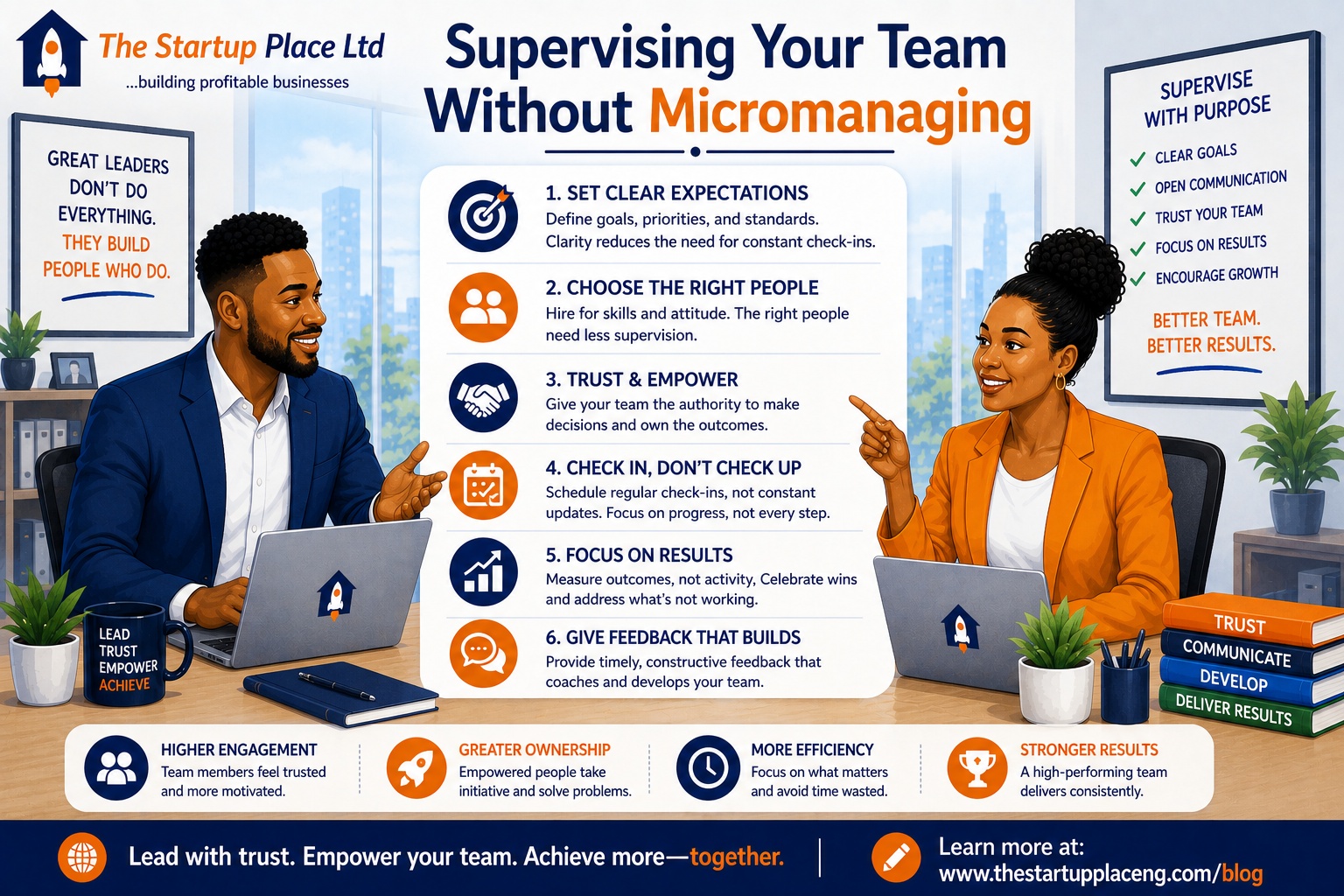
What Healthy Supervision Looks Like
When supervision is structured properly:
- Employees take more ownership of their work
- Communication becomes clearer and more efficient
- Mistakes are identified earlier
- The owner spends less time chasing updates
- Team confidence and productivity improve
The goal is not to watch every move. It is to create systems that support consistent execution.
Final Thoughts
Effective supervision is not about controlling people. It is about creating an environment where people can perform confidently and responsibly.
When systems are in place, business owners gain visibility without micromanaging, and teams operate with greater accountability and independence.
At The StartUp Place Ltd., we help businesses build operational systems that improve supervision, strengthen accountability, and reduce dependency on constant oversight.
If managing your team feels exhausting, the key question is not just “Why are they not performing?” but also “What systems are guiding their performance?”
Book a strategy call today to build systems that help your team perform without constant supervision.
The StartUp Place Ltd.,
Helping Businesses Move From Hustle To Structure